
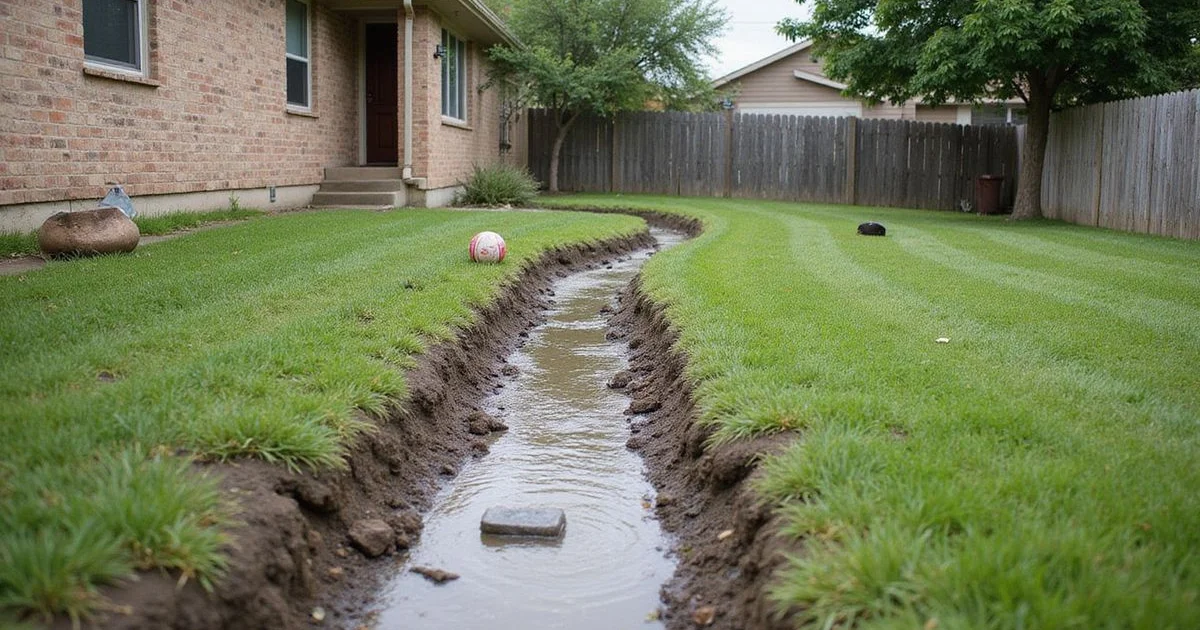
Water is the variable you can actually control
You cannot change the soil under your house and you cannot change the weather. You can change where water goes, and on expansive clay that is the most influential lever available to a homeowner.
That is why drainage and grading are part of every foundation evaluation rather than an afterthought. Frequently the most useful finding in a report is not a support recommendation at all; it is a downspout discharging three feet from a slab edge.
Surface grading
The ground should fall away from the foundation on all sides. That is the basic requirement, and a surprising number of properties fail it.
Grade reverses over time for ordinary reasons. Beds get topped up with mulch year after year until soil sits above the slab edge. Landscaping is added. Soil settles differently around the perimeter after construction. A new patio or path changes the profile.
The fix is often straightforward: re-establish fall away from the structure over the first several feet, keep soil and mulch below the slab edge, and avoid creating flat or reverse-sloping beds against the house.
Downspouts and gutters
The highest-value change on most suburban lots, and among the cheapest.
A roof collects a large volume of water and concentrates it at a handful of discharge points. A downspout emptying at the base of a wall delivers that concentration directly into the soil against your foundation, repeatedly, every time it rains.
Extensions that carry discharge well away from the structure solve it. Gutters that are clear and functioning are the prerequisite; a blocked gutter overflows along the wall line, which is the same problem spread out.
Swales
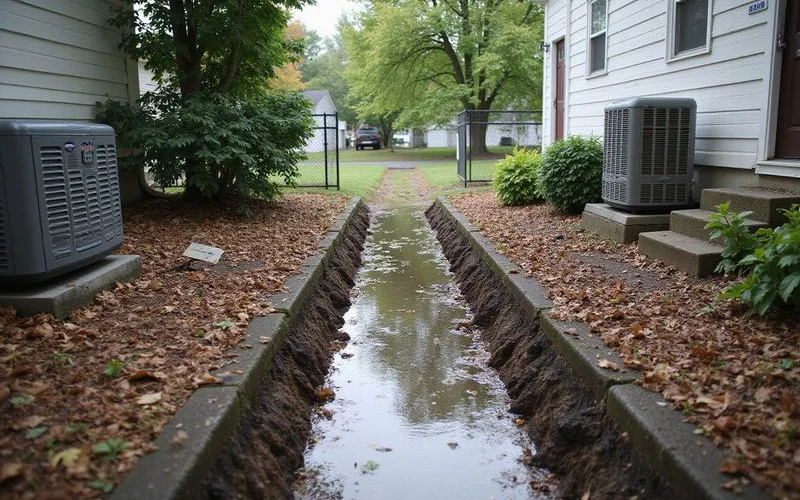
Graded subdivision lots across Pflugerville, Round Rock, Hutto, Kyle and Buda were designed with drainage swales between houses. These shallow channels carry surface water along defined paths to the street or a drainage easement.
They stop working when they are blocked. A fence post set in the channel, a shed, a raised bed, or landscaping fill that levels out the dip all interrupt the path. Water then sits where it was never meant to.
If water pools between your house and your neighbour’s after rain, that is worth a look. It is also worth checking before you build anything in a side yard.
French drains and subsurface solutions
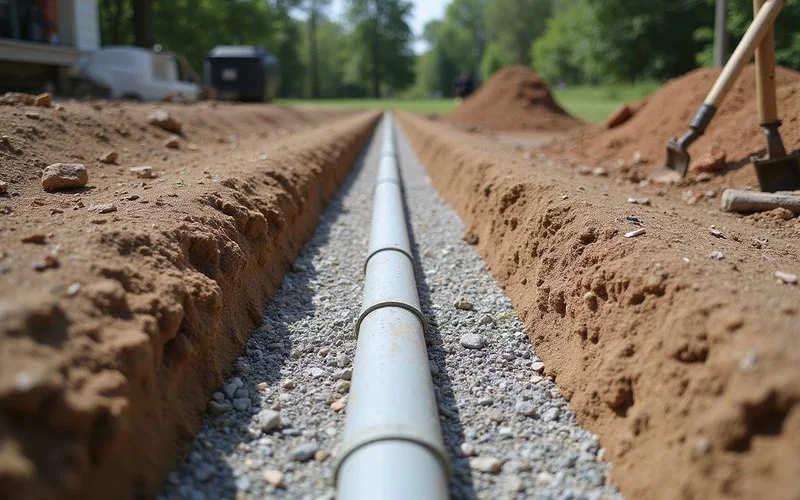
A French drain is a perforated pipe in a gravel-filled trench that collects subsurface water and carries it away. It suits situations where water collects and surface grading alone cannot move it: low spots, slopes delivering runoff toward a house, or persistent saturation in one area.
It is not a default. Plenty of properties are better served by correcting grade and extending downspouts, which is simpler, cheaper and less disruptive. Where a French drain is appropriate, the outlet matters as much as the trench; a drain with nowhere to discharge is a storage tank.
Consistency, not dryness
The goal is not to keep soil bone dry. It is to keep moisture reasonably even around the perimeter. One side saturated and one side parched is worse than both being moderately damp.
What an assessment records
| Item | What we look for |
|---|---|
| Grade | Direction and degree of fall away from the structure |
| Soil level at the slab edge | Whether soil or mulch sits above it |
| Downspouts | Where discharge lands |
| Gutters | Clear, functioning, adequately sized |
| Swales | Present, clear, doing their job |
| Irrigation | Distance from perimeter, coverage evenness |
| Hardscape | Patios, drives and paths directing water toward the house |
| Standing water | Where it collects and how long it persists |
Where it fits in the decision
Drainage correction is often the cheapest useful action available, and sometimes it is the whole recommendation. It does not reverse movement that has already happened, so it is not a substitute for structural work where readings show that is warranted.
What it does is address a contributing cause, which makes it worth doing either way. Our guide on foundation maintenance covers the ongoing habits that go alongside it, and what a foundation evaluation examines shows where the drainage walk-around sits within the wider assessment.