
What maintenance can and cannot do
Let us be honest about the limits first. No maintenance routine prevents foundation movement on expansive clay. The ground responds to weather, and you do not control the weather. If maintenance is not enough and something has already changed, see our overview of foundation repair in Austin.
What maintenance does is reduce the differences in moisture around your foundation, and differential moisture is what causes differential movement. Keeping conditions more even around the perimeter genuinely reduces stress on a structure. It is also cheap, which makes the ratio of effort to benefit unusually good.
Everything below is general care. None of it is a substitute for a foundation evaluation if you are already seeing changes.
Moisture consistency
This is the single most useful habit on clay soils, which dominate east of the I-35 corridor across Round Rock, Pflugerville, Hutto and much of east Austin.
Clay shrinks as it dries and swells as it wets. The perimeter of a slab experiences those swings fastest. A steady, moderate level of soil moisture through a dry summer reduces how far the soil contracts and therefore how much support changes.
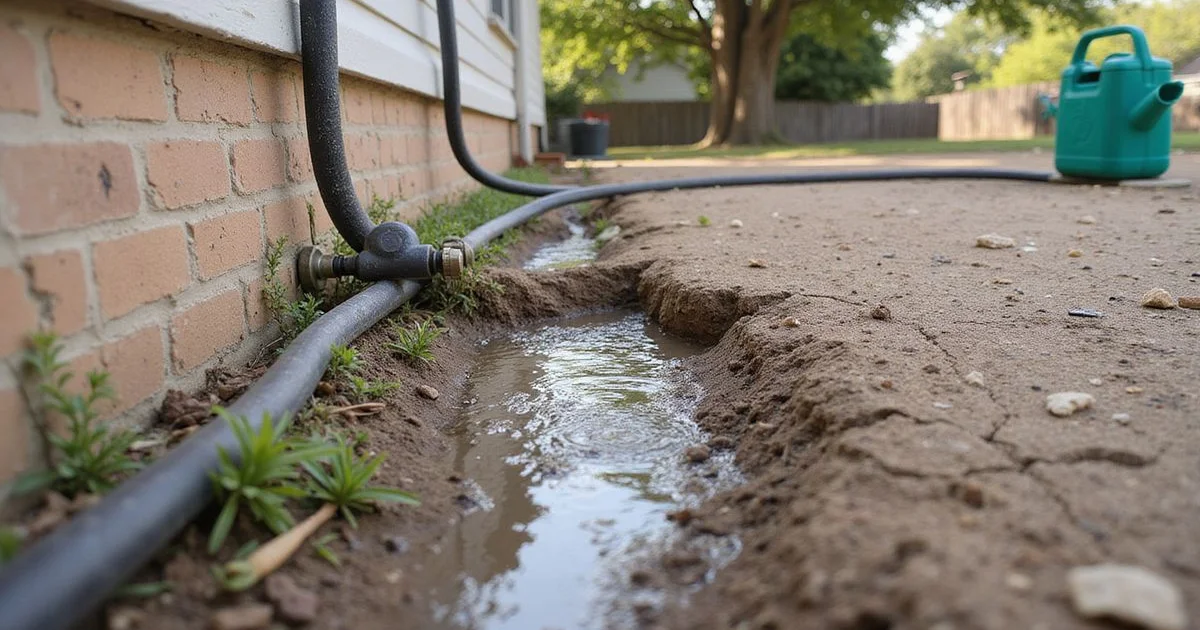
In practice: a soaker hose laid roughly a foot to eighteen inches out from the slab, run for a modest period on a regular schedule during dry spells. Even coverage on all sides matters more than volume. The most common mistake is watering only the side you walk past.
What to avoid: flooding a dried-out perimeter after weeks of neglect, which drives rapid swelling and can stress a structure as much as the drying did. Sprinkler heads spraying directly at the slab edge, which is uneven by design. And letting one elevation stay damp while another bakes.
Drainage and grading
Where moisture consistency is about adding water evenly, drainage is about removing excess water properly.
Ground should fall away from the foundation. Over time, settling, landscaping and mulch build-up reverse that on plenty of properties, particularly where beds have been topped up year after year until the soil level sits above the slab edge.
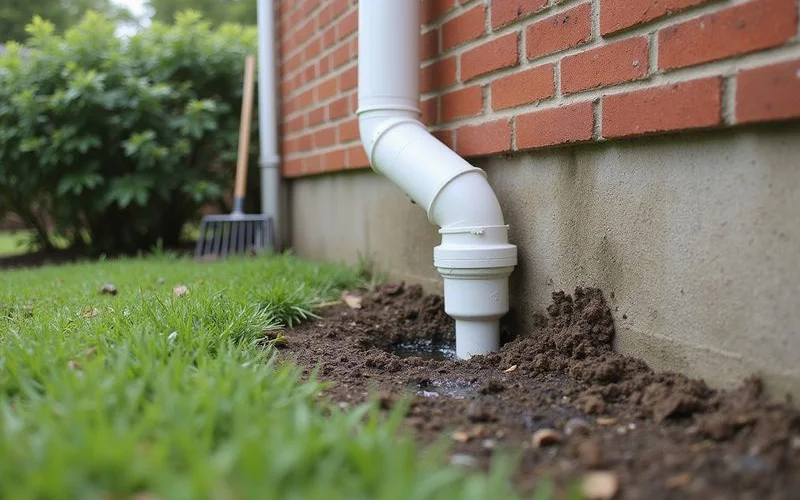
Gutters need to be clear and functional, and downspouts need to discharge well away from the structure rather than at its base. Extensions are inexpensive and are among the highest-value changes available on a typical suburban lot.
On graded subdivision lots across Pflugerville, Kyle, Buda and Hutto, drainage swales between houses carry water that the development was designed to move. Blocking one with a fence, a shed or a raised bed puts water where it was never meant to sit. Our guide on foundation drainage and grading covers what an assessment considers.
Watch what changed this year
New patios, extended driveways, removed or added trees, re-graded beds and altered irrigation all change how water moves. If something shifted, walk the perimeter after the next heavy rain and see where water actually goes.
Trees and planting
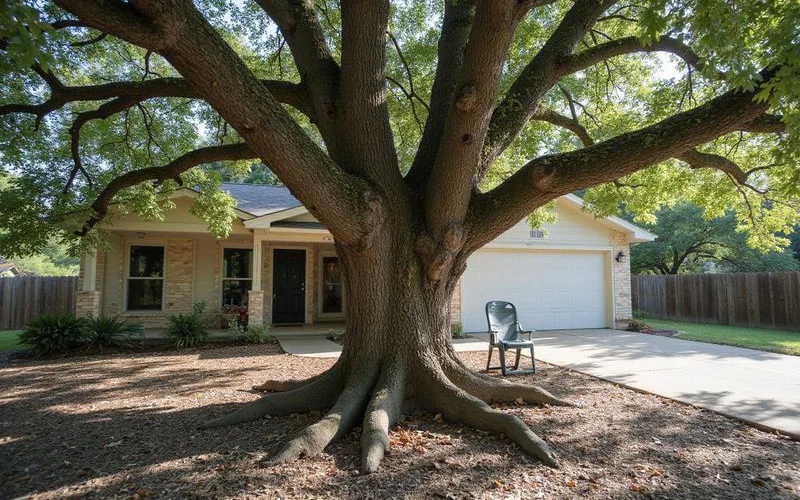
Mature trees are an asset and they do affect soil moisture. A large canopy draws significant water from the surrounding ground, which on clay can create a persistently drier zone on one side of a house.
That is a moisture issue rather than roots physically shoving a foundation, which is a common misconception. It still matters, because a dry zone on one elevation against normal moisture on another is exactly the differential you are trying to avoid.
Practical responses: maintain more consistent watering on the tree side during dry periods, avoid planting large species very close to the structure, and be thoughtful about removing a mature tree abruptly, because soil that has been dry for decades can swell substantially once the tree stops drawing from it.
Plumbing
An under-slab plumbing leak adds water where the soil was never meant to receive it, and that is one of the more common causes of localised heave in Central Texas.
Worth watching for: a water bill that rises without explanation, a warm spot on a slab floor, the sound of running water when nothing is on, or an area of yard that stays damp in dry weather.
A seasonal rhythm
| When | What to do |
|---|---|
| Late winter / early spring | Clear gutters, check downspout extensions, walk the perimeter after rain |
| Early summer | Set up consistent perimeter watering before the ground dries out |
| Through summer | Maintain even watering on all sides; photograph any new cracking with dates |
| Autumn | Re-photograph the same cracks after sustained rain and compare |
| After any major storm | Check where water pooled and whether swales are clear |
The photographs are the part people skip and the part that pays off. Dated images from the same positions turn next year’s observations into a comparison rather than a guess.
If your seasonal check turns up something that did not close back up, or several doors that changed at once, that is the point to get relative elevation readings rather than another season of watching. Background on why local ground behaves the way it does is in our guide on Austin soils and foundations.