
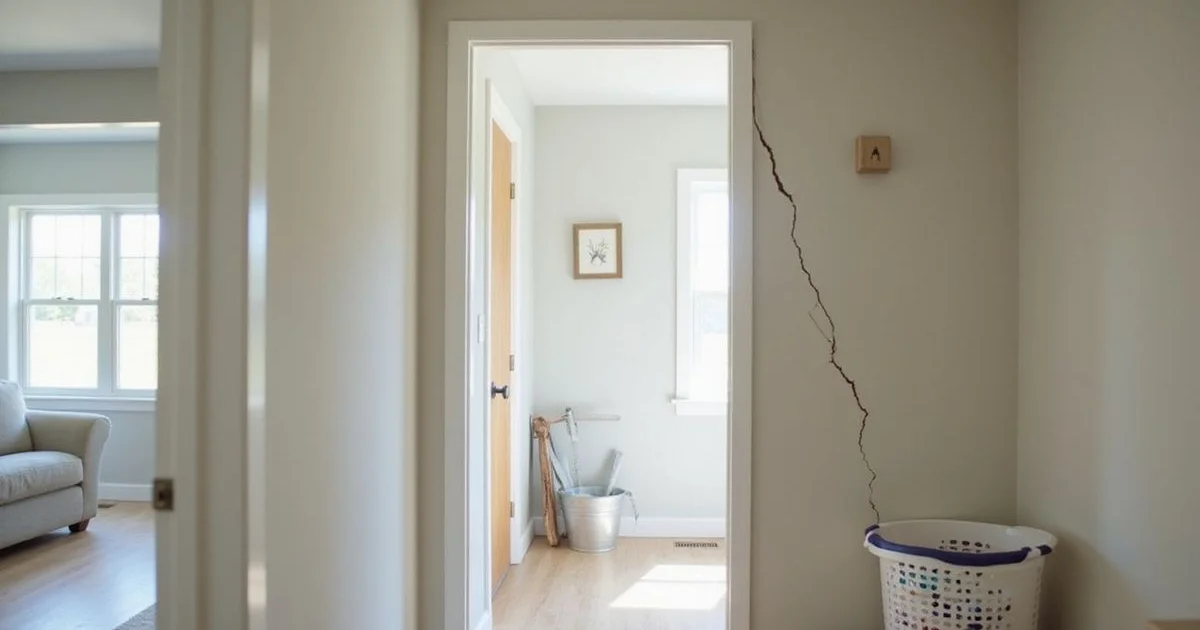
Not all interior cracks are the same
A crack in a wall is one of the most common reasons people start reading about foundations, and it is also one of the least specific signals a house produces. Drywall and plaster crack for a lot of reasons, most of which have nothing to do with the ground.
This guide separates the more informative ones from the background noise. It sits under our overview of foundation warning signs, which covers the full set of observations.
The more informative cracks
Diagonal cracks from opening corners. A crack running up and outward from the corner of a door or window frame is the classic movement cue indoors. Openings interrupt the continuity of a wall, so stress concentrates at their corners and shows there first.
Cracks with displacement. Where one side of the crack sits proud of the other, or the surfaces no longer line up. That indicates movement in more than one plane and carries more information than width does.
Repeating patterns. The same type of crack appearing at several openings, or along a consistent line through multiple rooms, suggests something systematic rather than local.
Cracks that reopen after repair. A patched crack that returns in the same place is telling you the underlying condition has not changed.
The less informative ones
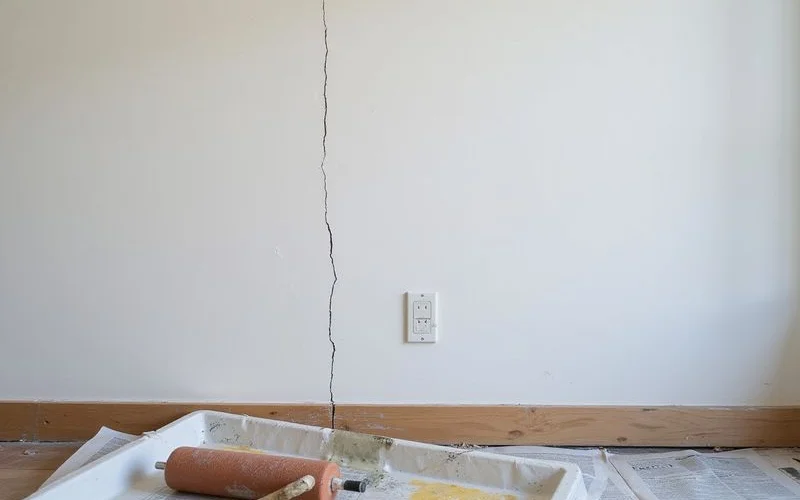
Fine straight cracks along drywall seams. Drywall sheets meet at taped joints, and those joints move slightly with temperature and humidity. Hairline cracking along a seam is extremely common.
Hairlines at ceiling and wall junctions. Different materials and planes meeting, responding slightly differently to seasonal change.
Small cracks in newer homes. Framing timber dries and shrinks over the first years after construction, producing cracking that has nothing to do with the ground.
Nail pops and single isolated cracks. Fixing movement and localised finish issues.
None of these are proof of nothing, and none are proof of something. They are simply lower-signal.
Gaps at trim and ceilings
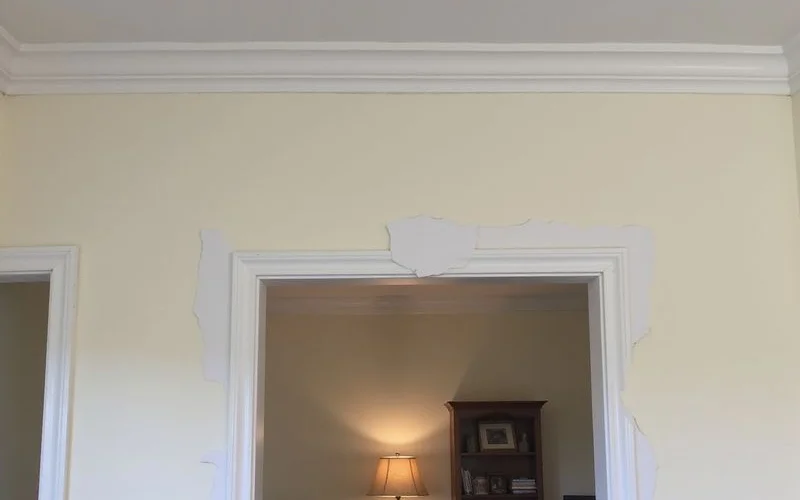
Separation between baseboard and floor, gaps at door casings, crown moulding pulling away from a wall or ceiling. These are useful because they change visibly over time in a way a hairline does not.
A gap that opens, closes seasonally and returns to roughly the same place reads differently from one that has widened steadily over two years.
What an assessment considers
| Factor | Why it matters |
|---|---|
| Location relative to openings | Corners of doors and windows concentrate stress |
| Pattern across the house | Systematic versus isolated |
| Displacement | Movement in more than one plane |
| Corresponding exterior cracking | Whether the veneer shows the same thing |
| Relative elevation readings | Whether the floor pattern matches the cracking |
| Age of the home | Early settling versus later movement |
| Season and history | Whether it opens and closes or has progressed |
That fifth row is the one that converts guesswork into assessment. Cracking at one end of a house where readings show the floor is low is a coherent picture. Cracking where readings show nothing needs a different explanation, and there usually is one.
There is no universal crack-width rule
No measurement in inches declares a home safe or unsafe. Width appears in some engineering damage classifications applied by qualified people alongside other evidence. It is not a DIY test.
What to document
Photograph each crack with something for scale, note which room and which wall, and record the date. Take the photographs from positions you can return to.
Note whether it appeared suddenly or gradually, whether it has changed, and whether anything else happened around the same time: a dry summer, a very wet period, plumbing work, a tree removed, a remodel.
Check whether there is corresponding cracking on the outside of the same wall. That correlation is genuinely useful.
And do not patch before the assessment. A filled crack tells nobody anything.
When to move from watching to measuring
If several openings across different parts of the house have started cracking at once. If there is visible displacement. If a patched crack has reopened. If cracking is accompanied by doors and windows that have stopped closing or a floor that feels newly uneven.
At that point a foundation evaluation with relative elevation readings will tell you in an hour what months of watching cannot.