
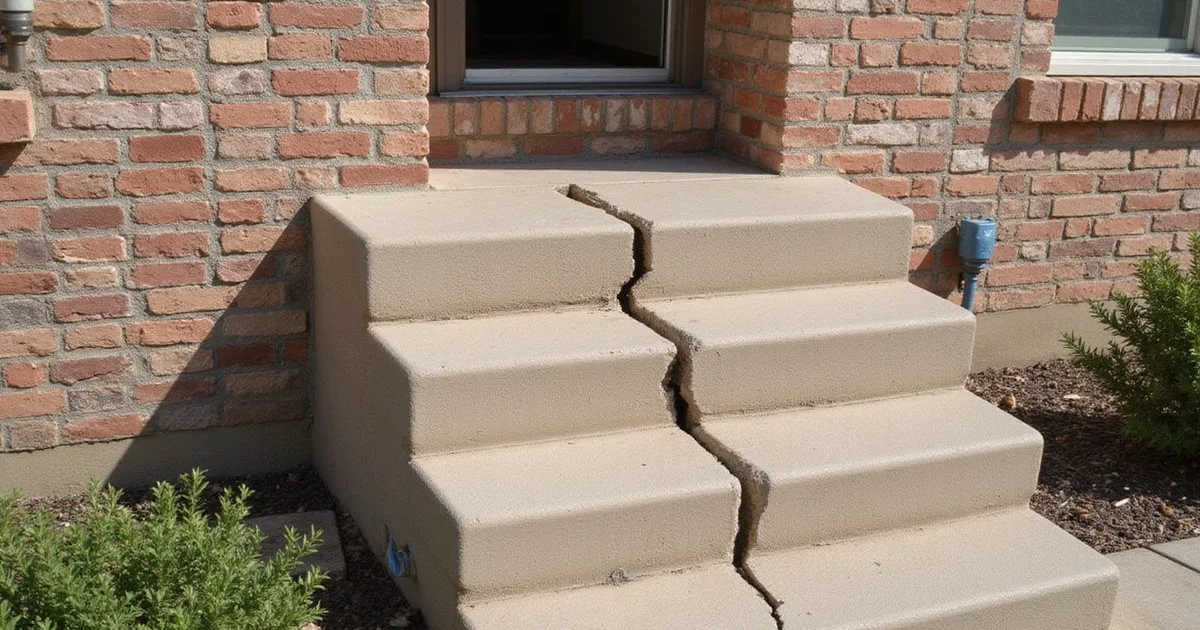
What you are looking at
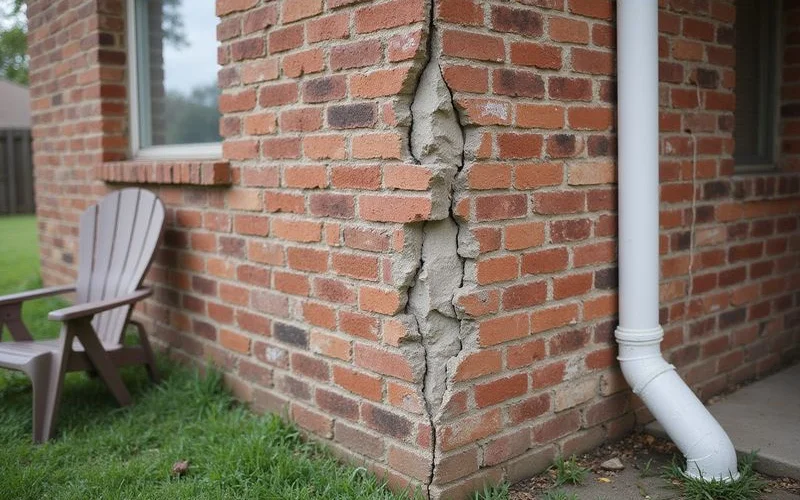
A stair-step crack follows mortar joints diagonally up a brick wall, stepping across and up in a staircase pattern. It usually starts near a corner, a window or a door opening, because those are the places where stress concentrates.
Brick veneer is rigid and unforgiving, so it shows differential movement readily. That makes it a useful indicator, and it also makes it alarming to look at. The two are not the same thing. For the broader set of observations, see foundation warning signs.
Why it steps through the mortar
Mortar is generally weaker than the brick units it bonds. When a wall experiences differential movement, the separation follows the path of least resistance, which means the joints rather than the bricks themselves.
The diagonal direction reflects the geometry of that movement: one part of the wall has moved relative to another, and the crack traces the boundary between them.
Worth remembering that brick veneer on most Central Texas homes is a cladding, not a structural wall. It is supported by the foundation and tied back to the frame. So veneer cracking reflects movement at the support level; it does not mean the wall is falling down.
What an assessment actually considers
Location and pattern. Where on the elevation, in relation to which openings, and whether similar cracking appears elsewhere. A single crack at one corner reads differently from cracking across multiple elevations.
Direction and width variation. Whether the opening is consistent along its length or wider at one end. A crack that widens toward the top suggests something different from one that is uniform.
Vertical displacement. Whether the bricks on either side of the crack still line up, or whether one side has moved up or down relative to the other. Displacement carries more information than width.
Relative elevation readings. The measurement that turns the observation into something interpretable. Cracking at a corner where readings show the floor is low is a coherent picture. Cracking where readings show nothing is a different conversation.
Drainage and site conditions. What is happening with water on that elevation, whether a tree sits nearby, and whether grade falls toward or away from the wall.
History. When it appeared, whether it opens and closes seasonally, and whether it has widened.
What appearance cannot tell you
| Question | Why the crack alone does not answer it |
|---|---|
| How severe is it? | No universal width rule applies to a home |
| Which way did it move? | Requires elevation measurement |
| Is it still moving? | Requires comparison over time |
| What caused it? | Movement, thermal effects and original construction all produce cracking |
| Does it need repair? | Depends on the pattern across the whole property |
Crack width appears in some engineering damage classification systems, and those are applied by qualified people alongside other evidence. They are not a tape-measure test you can run yourself.
Seasonal opening and closing is common here
On expansive clay, cracks that widen through a dry summer and narrow after sustained rain are a familiar pattern. What matters is whether the baseline shifts year on year.
What to document
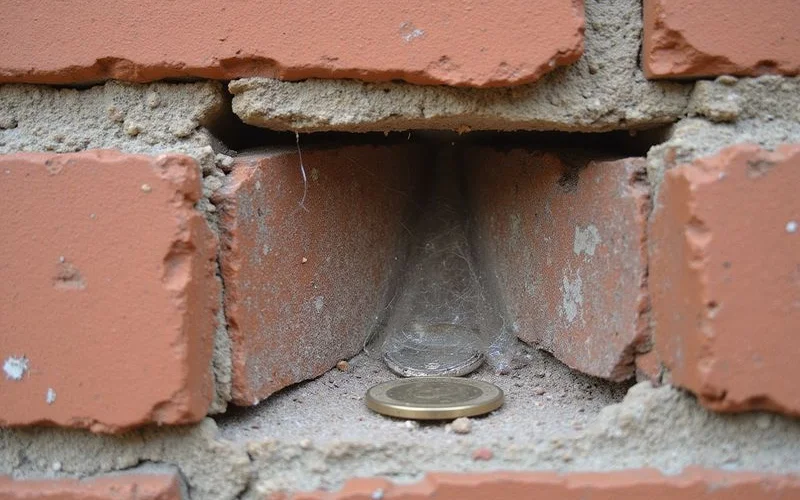
Photograph the crack with something in frame for scale, from a consistent position you can return to. Note which elevation it is on and roughly where. Record the date. Note whether the bricks either side still line up.
Then photograph it again after a stretch of sustained rain, from the same position. That comparison is worth more than any single opinion.
Also worth capturing: where the downspouts on that elevation discharge, whether soil has pulled away from the slab edge nearby, and whether there is a mature tree close to that wall.
The next step
A foundation evaluation with relative elevation readings. That tells you whether the crack corresponds to actual differential movement, how much, and in which direction, and it gives you a documented baseline for future comparison.
What you should not do is fill it first, act on a phone quote from a photograph, or conclude from width alone that your house is either fine or failing. It is also worth reading the pattern alongside what is happening inside, since interior wall and ceiling cracks often appear in the same period and help locate where the movement sits.